Showing posts with label Translation. Show all posts

Sunday, March 22, 2015

Dictionary of Linguistic Terms (English Urdu)

I am a translator. Yes, I am not a 'scholarly' translator. Even being a freelance translator, I feel helpless when there are no resources. Well, for me, resources are dictionaries, terminologies and word banks which help me translate quickly and efficiently. It is very hard to re-invent the wheel every time, when I do not find a standard translation of an English word. I must also admit that I am very lazy and try my best not to open any manual dictionary. So I am left online searching non-standard sources to find an equivalent of a given English term. The situation is not very promising. We need to digitize English Urdu dictionaries and terminology banks. While we are working on that, I have scanned an English Urdu terminology for linguistic terms for myself and the other translators out there. This is a searchable PDF (only for English text) and it can be very useful for someone who is as lazy as I am. A quick search by Ctrl+F will certainly give you a clue of the Urdu word you are looking for.
So after all this bragging, let us go to the link and download the PDF.
Book Name: Dictionary of Linguistic Terms (English to Urdu)
Editor: Professor Amir Ali Khan
Publisher: National Language Authority, Islamabad, Pakistan.

Wednesday, September 11, 2013

Translator as a Co-Creator

Translation is a process by which meaning in one sign system is transferred to another sign system. Here the term ‘sign system’ is limited to linguistic signs only. The person who does this act is called a translator, and bears the responsibility to transfer meaning from source sign system or source language (SL) to target sign system or target language (TL) in an as accurate as possible way. The dilemma of translation, and hence for the translator, starts from within the system of language and its nature. No two words in a language can have same meaning, they might be similar in some aspects but one hundred percent equality or synonymy is not possible. This dilemma widens when words belong to two different languages which have different cultural roots and are distant from each other on the basis of time and space.

It is said that translation is like planting and meaning is the plant which is taken from one soil and planted in a new soil. Meaning exists in a language system but it also has deep roots in culture because language is like a heart and culture is like a body to it. Both language and culture cannot live apart from each other, and upto some extent they do reflect in each other. So the translator is like a person standing on the boundary of one language and culture and importing something to another language and culture. This process needs to be done faithfully, creatively and carefully. During the process of meaning transfer, a translator has to carefully decide what to retain and what to loose. He has to carefully decide how much he has liberty to be creative while giving meaning a new dress of words. At the same time he needs to be careful and faithful to the original meaning of source language. This process can be seen on a continuum or scale of which one end is occupied by ‘creativity’ and the other end is occupied by ‘faithfulness to source’. The translator has to decide what to loose and what to gain on this scale, and according to subject matter, context, and personal taste and experience, he moves back and forth on this continuum or scale.

Subject matter or area of translation is the most powerful factor which affects the translator’s decision to be more creative or less creative. There are some subject areas which require little creativity and are simple to translate. The technology and science related areas, news reports and journalism, websites and software localization, manuals and tutorials etc. are some of the areas which have certain kind of universality. The concepts are usually universally shared and translator just has to change label for specific meaning or concept. Thus the process of translation becomes pretty straight forward with translator being faithful with the source as much as possible. On the contrary, translating a literary piece demands totally opposite skills from the translator. It is generally recommended that translator is also a writer in his mother tongue, or the language in which he is going to translate. He needs to be very careful with meaning but at the same time beauty and creativity are very important as well. He has to be innovative and creative in translation to target language, so that meaning – along with mood, connotations and denotations, formality and cultural ties – is transformed to target language. Juggling on all these fronts requires that translator takes the ‘sense’ of the source and creates something new in the target language. Though generally he may choose a different genre, but ultimately translation will be considered a piece of literature.

The matter of context and personal choice is of less importance as compared to subject matter of translation. The context decides whether translator needs to be creative or needs to retain original meaning of the source. Highly culturally rooted words, e.g. local dishes’ names, are examples which cannot be translated from one language to another. So the translator has to choose faithfulness with the source instead of creating something new. Translations of great literary works like “War and Peace” have made translators to choose original labels instead of using locally available synonyms because of the deep cultural roots of the source, which makes them untranslatable. The matter of understandability for the audience may also be a reason to choose source terms instead of target terms or creation of new ones. This is specially true in localization of modern day software and application programs, where a balance has to be maintained between innovation and/or creation and faithfulness with the source.

Concluding the essay, following opinion can be drawn. Translation is a creative process. A translator has to decide between creativity and faithfulness to source. Sometimes he will be creating new terms, labels and genres; he will be writing the original source in a new tone suitable for the target language. Other times he will be sticking with the source, and trying to imitate words, labels, structures and genres of the source into the target language. So a translator is at the same time a creator of something new as well as a retainer of the old. He is a ‘co-creator’ as well as a ‘translator’; and there are factors which influence the choice of these roles.

Monday, January 30, 2012

Urdu to English Dictionary

Translators are not super humans or machines which take input in one language and provide output in another. They are like ordinary people, but a bit clever in using a dictionary. So it is the dictionary which makes a translator 'actual' translator. As there is always a women behind a successful man, there is a good dictionary behind a successful translator, in this case I must say a bunch of dictionaries. :-) As I work as a translator English <-> Urdu and Punjabi. En <> Ur combination is mostly demanded and for this purpose I am in a continuous need of dictionary. I had a dictionary for English to Urdu, as I mentioned here my adventure to integrate dictionary word list to OmegaT. 

This dictionary solved half of my problem i.e. En > Ur. But the revrse was still a headache. I always had to refer to UrduEnglishDictionary.org for searching English equivalents of Urdu words. But then, as I always sometimes do, I woke up and decided to do something on my own. So what I've done is changed the English > Urdu wordlist to work for Urdu > English purposes. It is a dirty solution, there are still lots of problem in the word list, and ideally there should have been a word list typed specifically for Urdu > English purposes. But this quick dirty solution works in most cases for me. And I am sharing it here online, so people struggling for Urdu > English equivalents may get some relief. There are lots of good dictionaries out there, but this is yet another dictionary in already available variety. And hopefully it will benefit other translators and users.
Urdu to English Dictionary in C#
There is nothing fancy, no help, no license and no xml type system to store word list. The word list is simply a text file with entries on new line and Urdu words are separated from English counterparts using a tab. The dictionary loads this file and then searches for appropriate word. The search pattern in very simple. By default it will search for exact match (which is dictionary look up method of c#) and additionally it will iterate through all dictionary key value pairs and add the entries which start with search query. The second radio button, if checked, will only give exact match, or if nothing found there won't be any result. This much is sufficient for me in most cases. I am hoping it would be for most people as well. It is compiled on Windows 7 64 bit. So I am not sure whether it would work on every system (including Windows 7 32 bit). But I am attaching source project as well as compiled dictionary. The project can be compiled using Sharp Develop 4. The dictionary assumes that you have installed Jameel Noori Nastaleeq. Please get it if you don't have.
Dictionary
Source Code (Sharp Develop Project) 

Update: Another dictionary was added afterwards, a 27000 words dictionary provided from Alqlm.org.
Dictionary
Source Code

Sunday, December 11, 2011

Text Summarization Tools and Translation

Today I was (again) requested by one of my clients to translate (the news reports I do for them) in a way that they are summarized. So the readers may not have to go to unnecessary details which they are not interested in. I've tried to go around this request previously, because it was hard for me to provide extra time for "summarization" of the text, then translating it. Being a translator means you do not need to read the passage twice. You keep on reading sentence by sentence and keep on translating. It is very rare when the text is not familiar and translator has to read it first to get an overall idea of it. So I was being selfish in the same way, because I had to be give extra time for same work.

Well, having said that, today when I received the request again, I tried to find a work around. Where I could be happy as well as my client. And I got hit by the idea of automatic text summarization tools. That was amazing, I was so too much excited. I went to google and started searching "creating summary of text". And it gave me a bunch of tips every time "how to write executive summary" and bla bla bla... Well, that didn't go well, I said to myself. And then I changed the keywords to "text summarization tool". And I found some clues, an offline application and then some very exciting online tools which worked for me. So I used automatic summarization tools online today for the first time. I summarized a news report (in English) and then translated it. This way my client got happy (I am hoping so) and I am a happy guy also. So I wanted to share these tools here, in case someone might need to summarize his English text before translating it.

It is the best tool I've got today. It is based on an open source summarization tool. And I think a very good implementation. It works fine for longer texts as well as short. My experience with a 600 words or so text was that it summarized it almost half when I chose 50%. But for a 400 words text, it didn't shorten it to almost or exact half, but returned the same. Then I selected 30% (even 35 or 40 didn't work either) and it gave a very compact summary of the text. So I think next time I should get a one third of longer texts as well so to incorporate more news reports in my daily professional Urdu translation limit for that client.

It was pretty good too, but it is a demo version. Additionally it was not that good as the above one. So I left it.

This one was what I got at number one. It is actually written for Swedish but supports a number of languages including English. The tool is pretty much old and looks like not maintained anymore. It gives some good options for summarization as well, but its result is not very good. After getting the summary of longer text (same as used for text compactor) I had a feeling that automatic summary may not work for me. It focused too much on data and statistics, two sentences were subject less, and the ending part (which I think should have been part of the summary) was also omitted. So I had to add it on my own. But later text compactor solved the problem. I am hoping it will go on solving the problem for me. Because I cannot afford providing extra time for summary and then translation, or deciding what should be included and what should not be (in translation).

So folks, if you even get a chance when you need a summary. Do try these online tools, they work good.

Thursday, September 22, 2011

Creating an Urdu Translation Glossary with C#

After a long time I have come back to C#. My limited skills allow me to do some things only with text processing and as I trained my self, my little silly looking C# scripts deal with file operations, getting word frequencies, getting counts from different text files etc etc. As I use C# as Python or other scripting language should be used, to write small programs to do tiny miny things, so I consider myself less of a programmer. But still I am in between a layman and a programmer, and can write a few bits of code. This time, after several months when I came back to C#, it was the urge to create an Urdu Glossary which can work with OmegaT. OmegaT is an open source translation memory tool, and I use it for most of my translations. And I need dictionary constantly as well, but the dictionary I use Urdu Web Lughat which is written in C# 2 and fits my purpose very well, when I add this Lughat File instead of default file which has only a few thousand words. This file has 92661 words and expressions which usually provide me insight for the correct translation, not to mention several other Urdu lughats have been merged with original few thousand words file to create this file. Well it serves the purpose, but it creates problem as well. I have to type each word in its lemma form i.e. if it is a verb in with third form e.g. got, I’ll have to write fist form get to get the meaning. Other problems are with the application.
urdu-web-lughat
Urdu Web Lughat
As the picture shows, capability to search the desired word from Google, Wikitionary, and Urdu Wikipedia as been added to it. This is done by default Internet Explorer Engine provided for C# 2005, but it creates problem while using in higher versions of Windows e.g. Windows 7. Each time I seek a word, it will show 2 or more dialogue boxes showing this error.
lughat-error
Urdu Web Lughat Error
I think I’ve the source code and can fix the problem by simply disabling this feature. But my other problem remains, that is typing the word each time, it takes too much time. So I was seeking for a solution. The solution I figured out was simple, put the lughat file in OmegaT somehow. And that’s possible through dictionary or glossary setup of the program. I find the dictionary process of OmegaT quite complicated (it requires Star Dict format). So I think its more feasible to put a glossary file instead (which is in this format word-tab-meaning). This was easy for me. I wrote a regular expression to match the lughat file’s xml and to extract each word meaning node (Don’t tell me it would have been easy with xml parser, I do not know it so regex was best for me). So here is the code I used to convert the nodes of xml in tab separated text file with each word meaning pair on new line.
public static void test ()
        {
            string match = "\\<I\\>\\s*\\<w\\>(?<Word>[^><]+)\\</w\\>\\s*\\<m\\>(?<Meaning>[^><]+)\\</m\\>\\s*\\</I\\>";
            string text = File.ReadAllText(@"G:\Software\Dictionary\dictionary.xml");
            Console.WriteLine(text.Length);
            //Console.Read();
            MatchCollection m = Regex.Matches(text, match);
            StreamWriter sw = new StreamWriter(@"G:\Software\Dictionary\Glossary.txt", true);
            string word = "";
            string meaning = "";
            Console.WriteLine(m.Count);
            //Console.Read();
            for(int i=0; i<m.Count; i++)
            {
                word = Regex.Replace(m[i].Groups["Word"].Value, "[\\r\\n]+", " ");
                meaning = Regex.Replace(m[i].Groups["Meaning"].Value, "[\\r\\n]+", " ");
                sw.WriteLine(word+"\t"+meaning);
                Console.WriteLine(word);
            }
            sw.Close();
        }
I know it could be improved a lot, but it did the work and did it pretty soon. I put the glossary file in OmegaT project folder as it was required (/project/glossary/Glossary.txt) and that’s done.
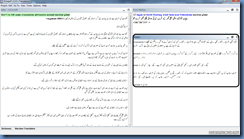
OmegaT-with-UrduGlossary1
OmegaT with Glossary 1
I was able to see the word meaning for each sentence in the glossary box in lower right box. It was quite a help for me and reduced my time. But then came the other problem: I still had to go to dictionary and type the lemma forms of verbs and plural nouns, so there was no meaning available for worked, working, works but only for the 1st  form i.e. work. This was quite frustrating for me because the actual problem was still there. So I decided to add the other forms of the words which had more than one forms. I decided to add new lines in the glossary for each form of verb, and add lines for plural forms of nouns as well. The idea was simple enough, but to accomplish it I had to grab a lemma list. Fortunately, being a corpus linguistics student, I know one out on internet. E_Lemma.txt has been created for Word Smith Tools, but I used it for my purpose. The code I used to extract lemmas of each word, and add them to new glossary file is below.
public static void Main(string[] args)
        {
            string[] lines = File.ReadAllLines(@"G:\Software\Dictionary\Glossary.txt");
            string[] lemmas = File.ReadAllLines(@"F:\Corpus Related\e_lemma.txt");
            string word = "";
            string meaning = "";
            string lemma = "";
            StreamWriter sw = new StreamWriter(@"G:\Software\Dictionary\Glossary2.txt", true);
            int count = 1;
            foreach(string line in lines)
            {
                Console.WriteLine(count+" of "+lines.Length);
                word = Regex.Split(line, "\t")[0].Trim();
                meaning = Regex.Split(line, "\t")[1].Trim();
                lemma = giveLemma(word, lemmas);
                if(lemma!="")
                {
                    foreach(string lemma1 in lemma.Split(' '))
                    {
                        sw.WriteLine(lemma1+"\t"+meaning);
                        Console.WriteLine(lemma1+"\t"+meaning);
                    }       
                }
                else
                {
                    sw.WriteLine(word+"\t"+meaning);
                    Console.WriteLine(word+"\t"+meaning);
                }
                count++;
            }
            sw.Close();
        }
        public static string giveLemma (string word, string[] lemmas)
        {
            string toReturn = "";
            string lemma1 = "";
            string lemma2 = "";
            foreach(string lemma in lemmas)
            {
                lemma1 = Regex.Split(lemma, "->")[0].Trim();
                lemma2 = Regex.Split(lemma, "->")[1].Trim();
                if(word==lemma1)
                {
                    toReturn += lemma1 + " " + Regex.Replace(lemma2, ",", " ");
                }
            }
            return toReturn;
        }
As it can be seen, the task is pretty simple.
  • Get each line from previously made glossary file.
  • Split the word and meaning.
  • Pass the word to another function, along with the lemma list (got from e_lemma.txt file) and return all possible forms of a verb or a noun.
  • At the end write a new line for “word-tab-meaning” pair for each lemma form of verb or noun.
  • And if there is no lemma, simply write the original word meaning pair.
The task was simple but the code was quite inefficient, so it took a long time to do this task. It took almost 1.5 hour to do it. But it was done and worked like a charm. See Smile
OmegaT-with-UrduGlossary2
OmegaT with Glossary 2
So a glossary for Urdu Translators working with OmegaT is available. And of course it can be downloaded from here.

Saturday, August 20, 2011

Getting Money

A few years back it was a great achievement for me was to get a few hundred rupees. I can remember myself teaching a student a home tuition for Rs 400. I had to travel almost half an hour on cycle to reach there and had to provide 1 hour. Once that was a great achievement for me. Then the life changed a bit, I taught in academies, typical tuition academies of our cities. I worked as a computer assistant and so on. It was 2007, perhaps when I met Talmeez. Talmeez is a great person, he works as a translator and while on a visit to Faisalabad he especially came to meet me. We had a talk for a while, he wondered how extra smart I was :-) (rather he was concerned that I am so weak physically as compared to my age, but that's what I always have been so I didn't worry on his comments). He encouraged me to do something for my livelihood along with education. He gave me idea to work as a Translator from English to Urdu, and Punjabi. At first, as I always do, I didn't take the idea seriously. I was busy in my self created busyness, doing nothing but busy. Then after in a few months I started exploring options how to work as a translator, the websites, the marketing options, the companies. I created a CV of mine (really poor one at that time) and started sending it to job posters (which allowed of course direct contact). And in a few months I started getting jobs. And now I earn, not regularly, but whenever it is possible to grab a translation project, I have reasonable money in my hand which usually goes to my MSc, M Phil etc fees. But I am happy. Allah provides me with Rizq this way, and I am thankful to Him. And now in mid 2011 when I am going to leave private school job, I'll consider blogging, specially for linguistics, to be my part time profession along with translation.

Friday, August 19, 2011

Private Schools

I am a teacher by profession but this is unfortunate that I've to teach in a private school of my city. I as fascinated by the name of this school exactly 1 year back from now. I, as a fresh graduate, needed a job and was almost dancing with joy when I was offered "internship" at this school. We, a group of 5 students, joined them as internees at a handsome amount (Rs 9000 was considered by us as a handsome amount being a trainee at that time). But the charm vanished just after a few months. We were time and again refused for any increase in pay. The environment was helpful in training but the disgrace and a kind of humiliation, undue pressure exerted on the employees was unbearable. Now after one year, we are only two there. And I am also planning to leave this school to concentrate on M Phil Applied Linguistics plus work as a freelance translator.
I admit that I've learnt a lot from there. I was trained from a raw teacher to a professional, I learnt how to deal with parents, how to contain my anger while teaching, how to teach effectively, but still I do not feel comfortable there. There is an air of mistrust. The junior staff is burdened with extra work while seniors sit and relax. The organization is always suspicious that this person is going to run away. They do not want to pay, so there is no incentive for hard working. The old crows, the teachers who are working there for several years are the only things which can survive in that environment, new staff usually runs away after one year, as I am now planning to go away.
Perhaps same is the situation with every private organization. But I've learnt one thing that these private schools are money making factories. The teachers working there are labourers in colourful clothes. And the product the produce is half Pakistani half English O/A level graduates who feel it very hard to integrate with traditional educational system of Pakistan when they have to pass entry tests for MBBS or UET (engineering). They are the children of factory owners, and their Faisalabad lies around Canal Road, D Ground, Madina Town, Peoples Colony and other posh areas of the city.
Well, the post is diverting from the topic. My aim was to write about the atrocities of these private employers who are sucking blood from the veins of nation on the name of education.

Thursday, August 4, 2011

New Laptop, New Profession and New Academic Year

After struggling for more than a year finally I've got a new laptop for my personal and professional use. The HP ProBook 4530s Core i5 is just what I wanted. The 500 GB Hard Disk, 1 GB Redeon graphics card and Windows 7 64bit makes it a sexy choice. Although I am a bit disappointed with quite low native resolution of the LED screen but it would for me. And screen shots will be uploaded some other day ;-).
I am leaving school finally and they'll be notified about my departure in next 3 months. Now I want to focus on online jobs. I am working as a Community Manger for Netlog's Urdu version. I am working as a translator as well, and now I'll concentrate on English blogging as well. The things are going to be online from now on.
This year has become another transition year for me. After 1 year of absence and working as a mule for money, I am going to resume my studies in M Phil. And I am hoping to perform same way as I was doing in MSc Applied Linguistics. And I am concentrating to get some research papers published. This last thing is a bit tricky because I had to complete this task last month but as I had no mode, I couldn't complete it.
So this was on my mind. :-)